
Deep Learning Explained: How Neural Networks Learn to See, Hear and Read
Open your photo app and search for "beach." A second later it shows pictures from three summers ago, none of which you ever tagged. Nobody wrote a rule describing what a beach looks like. The software worked it out by studying a very large number of examples.
That ability comes from deep learning, the branch of artificial intelligence behind modern image recognition, voice typing and language tools. It is often described in almost mystical terms, which hides how practical, and how conditional, it really is. This article explains what deep learning is, how a neural network learns, where it earns its place, and where a simpler approach is the smarter choice.
Where deep learning fits
Deep learning is a subset of machine learning, which is itself a subset of artificial intelligence. AI is the broad goal: systems that perform tasks that normally need human intelligence. Machine learning is one way to get there, by letting a system learn patterns from data instead of following hand-written rules. Deep learning is a particular kind of machine learning built on neural networks with many layers.
What is a neural network, and what makes it "deep"?
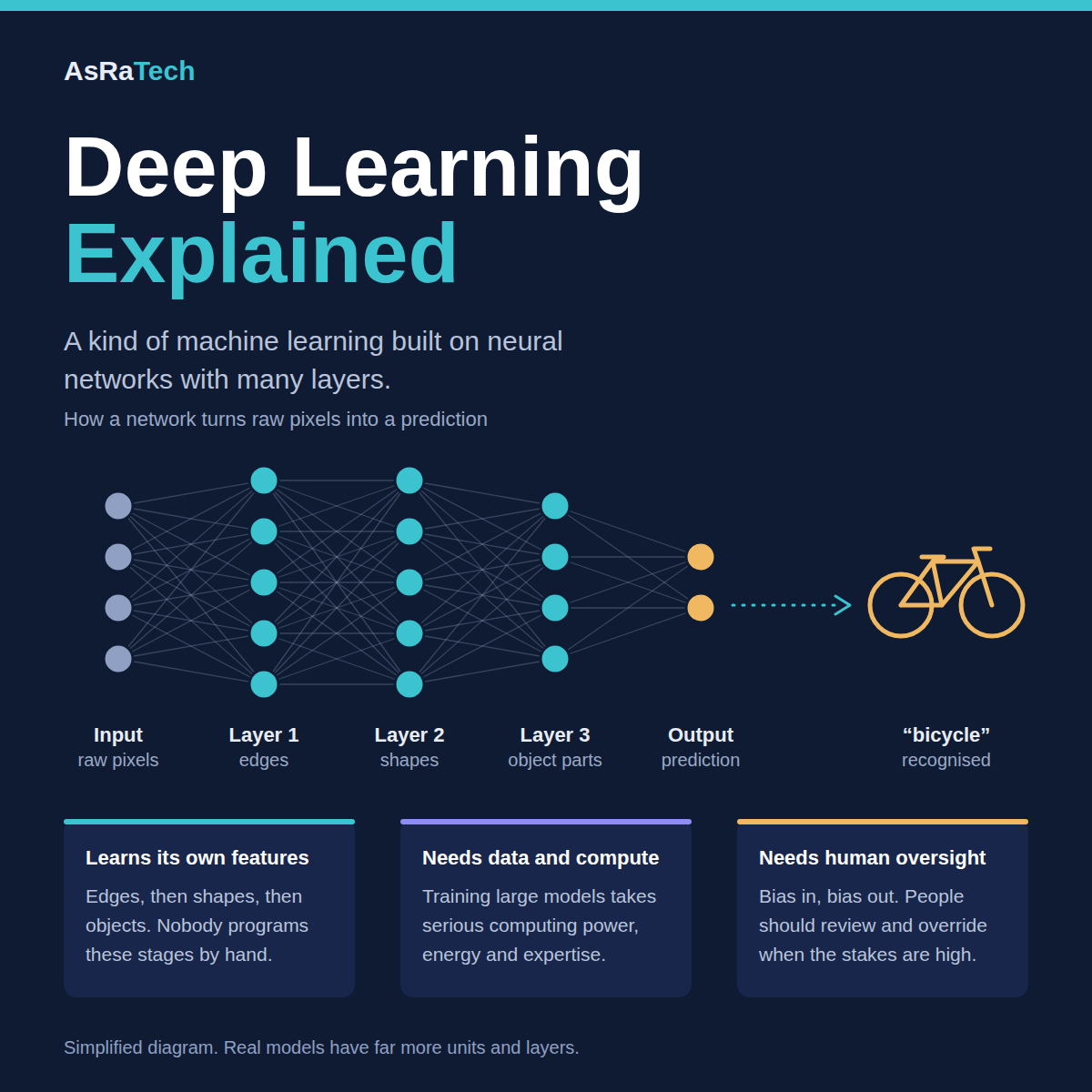
A neural network is a stack of layers made of small computing units, often called neurons. Each unit takes in numbers, weighs them, and passes a result forward. The idea is loosely inspired by the brain, but the resemblance stops at the metaphor. It is arithmetic at scale, not a digital mind.
The "deep" refers to the number of layers. Between the input and the output sit several hidden layers, and each builds on the one before it. In an image model, early layers tend to respond to simple things like edges and changes in colour. Middle layers combine those into shapes and textures. Later layers assemble shapes into things we would actually name, such as a wheel, a face or a bicycle. Nobody programs these stages by hand. They emerge during training.
How a network learns
Training follows a loop that is simple to describe, even though the arithmetic behind it is heavy.
- Make a guess. An example goes in, say a photo labelled "bicycle." With random starting settings, the first guess is usually wrong.
- Measure the error. A loss function scores how far the output is from the correct answer.
- Adjust. A method called backpropagation works out which internal settings, known as weights, contributed most to the error. Gradient descent then nudges those weights in the direction that reduces it.
- Repeat. The loop runs over the dataset many times until improvement levels off. Finally, the model is tested on examples it has never seen, which shows whether it learned the pattern or merely memorised the training set.
Each nudge is tiny. Repeated millions of times, the nudges add up to a model that can read handwriting or transcribe speech.
Why deep learning handles messy data so well
Traditional machine learning often depends on people deciding which features matter. For a loan model, that might be income and repayment history. For a photograph, the question is much harder: which numbers describe "a cat"? Deep learning sidesteps the problem by learning its own features directly from raw pixels, audio waveforms or text. That is why it dominates work with unstructured data.
The price is appetite. The graph below illustrates a commonly observed pattern: with limited data, simpler methods can match or beat a deep network, while with large datasets deep models often keep improving after others level off.
The main architectures at a glance
"Deep learning" is a family, not a single method. Different network designs suit different kinds of data.
ArchitectureBest suited toTypical useConvolutional network (CNN)Images and videoDefect detection on a production line, photo searchRecurrent network (RNN, LSTM)Sequences such as sensor streams and time seriesForecasting, earlier generations of speech recognitionTransformerLanguage, and increasingly images, audio and codeChatbots, translation, summarisationAutoencoderCompressing data and spotting anomaliesFlagging unusual equipment readingsGenerative models (GANs, diffusion)Creating new images, audio or other contentImage generation, design explorationDeep learning versus traditional machine learning
Deep learning is not automatically the better option. It trades some things for others, and the chart below shows where.
Where deep learning earns its place
- Computer vision. Networks inspect products for defects, read documents and sort images, often faster and more consistently than manual checks.
- Speech and language. Voice typing, translation, summarisation and search all rely on models that treat language as patterns to be learned, not grammar rules to be coded.
- Healthcare support. Models can highlight areas of interest in medical images, giving clinicians a second signal. The professional still makes the call.
- Anomaly detection. Learning what "normal" looks like in sensor data or network traffic makes unusual behaviour easier to spot, whether it signals a failing machine or an intrusion.
- Recommendations. Platforms combine behaviour and content signals to suggest what each person may want to watch, read or buy next.
What a real project looks like
Many people picture deep learning work as designing clever networks. Practitioners will tell you that much of the effort goes into data: collecting it, cleaning it, labelling it and checking that it represents the real world. The pie chart below shows a typical split for illustration. Real projects vary.
Limits worth knowing
A balanced view of deep learning includes what it does badly.
- It needs data, and inherits its flaws. If the training data is skewed or incomplete, the model learns that skew. Bias in, bias out.
- It is resource-hungry. Training large models takes serious computing power, energy and expertise, which affects cost and sustainability.
- It can be hard to explain. With millions of weights, tracing why a network made a specific decision is difficult, which matters in lending, hiring and healthcare.
- It can be confidently wrong. A model can give a fluent, certain-sounding answer that is simply incorrect, or fail on inputs unlike its training data.
- It can be attacked. Carefully crafted inputs can fool a model, and personal data used in training raises privacy duties.
The practical response is human oversight: people who can review, question and override the system when the stakes are high.
Is deep learning right for your problem?
A useful habit is to start from the data and the decision, not from the technique.
Your situationA sensible starting pointImages, audio or free-form textDeep learning, often starting from a pre-trained modelStructured records such as sales or finance tablesSimpler machine learning methods first; they are fast and easier to explainA small datasetSimpler models, or fine-tuning an existing model instead of training from scratchEvery decision must be explainableInterpretable models, or deep learning paired with explanation toolsDecisions that significantly affect peopleAny model, with human review built into the processThe takeaway
Deep learning is neither magic nor a replacement for every other method. It is a powerful way to learn from unstructured data such as images, sound and language, and it comes with real costs in data, computing power and transparency.
The teams that get value from it begin with a clear problem, an honest look at their data, and a simple baseline to beat.
Understood that way, deep learning is less a mystery and more a tool: one worth knowing, and worth using carefully.