
Ensemble Models: Why a Crowd of Algorithms Often Beats the Best Soloist
In 1907, the statistician Francis Galton published a curious finding from a livestock fair: when hundreds of visitors guessed the weight of an ox, the middle estimate of all the guesses landed within about 1% of the true weight.
Machine learning has borrowed that idea, and it works for the same reason. Instead of betting everything on one model, you train several, let each give its answer, and combine the results. This approach is called ensemble learning, and it sits behind some of the most reliable systems in data science.
This article explains what ensemble models are, why they work, the main ways to build them, where they are used, and when they are not worth the trouble.
What is an ensemble model?
An ensemble model is a system that combines the predictions of several individual models to produce a single, final prediction. The individual models are often called base learners. Each one may be fairly ordinary on its own. The value comes from how their answers are put together.
Think of a panel of doctors reviewing a difficult case. One doctor may miss something, but a group with different experience tends to catch more, and a clear majority view is usually more trustworthy than one person’s hunch. Ensemble learning applies the same logic to algorithms.
Why combining models works
The key idea is that different models make different mistakes. One may be thrown off by an unusual data point, another may be too rigid, another may chase noise. If their errors are not identical, then when you average or vote across them, many of the individual errors cancel out.
This has a practical consequence. Single models tend to suffer from one of two problems:
- High variance. The model is too sensitive to the exact data it was trained on. Change the training data slightly and its predictions swing. This is overfitting.
- High bias. The model is too simple to capture the real pattern, so it is consistently wrong in the same way.
Ensembles are a way of attacking both. Some methods mainly reduce variance, others mainly reduce bias. Knowing which problem you have helps you choose the right method.
One condition matters a great deal: diversity. A hundred copies of the same model making the same mistake add nothing. Ensembles help when the members are different enough that their errors do not all point in the same direction.
The main ways to build an ensemble
For hands-on code examples of every method below, see scikit-learn’s ensemble guide
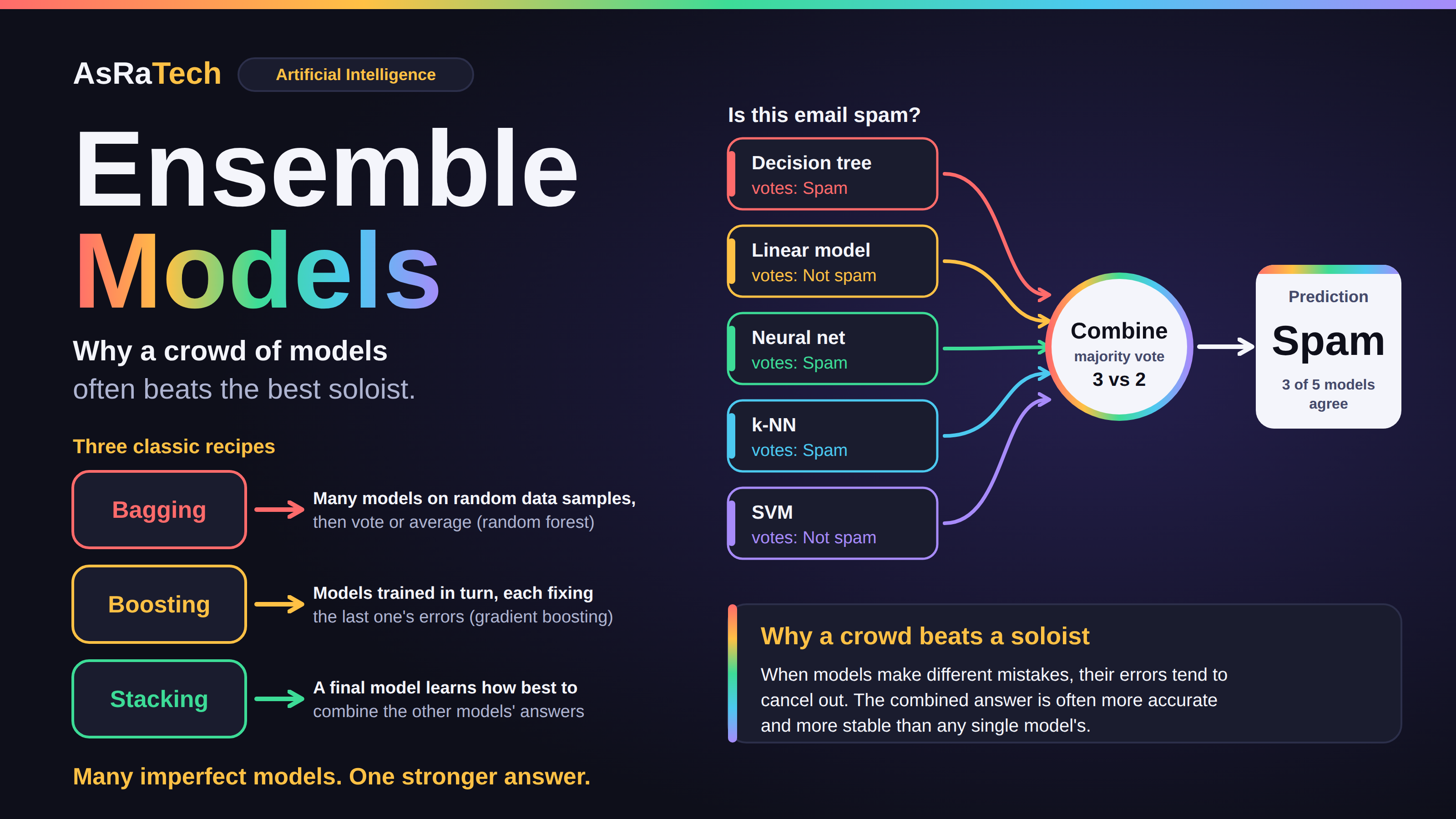
BaggingBagging, short for bootstrap aggregating, trains many models in parallel, each on a different random sample of the training data. Their predictions are then combined by voting for classification or averaging for numbers.
Because each model sees a slightly different slice of the data, each makes slightly different mistakes, and combining them smooths out the noise. The best-known example is the random forest, which builds many decision trees on random samples of the data and random subsets of features, then lets them vote. Random forests are popular because they are strong out of the box and relatively forgiving.
BoostingBoosting works in sequence instead of in parallel. A first model is trained. The next model then concentrates on the examples the first one got wrong, and the next focuses on what the second still misses, and so on. The final prediction combines all the models, usually giving more weight to the stronger ones.
Where bagging mainly calms a model that is too jumpy, boosting turns a collection of simple, weak models into a strong one by repeatedly correcting errors. Methods such as AdaBoost and gradient boosting, along with widely used libraries built on gradient boosting, are standard tools for working with tables of structured data, and they feature prominently in data science competitions.
StackingStacking combines models of different types. A set of base models, for example a decision tree, a linear model and a neural network, each make a prediction. Then a final model, sometimes called a meta-learner, learns how best to combine those predictions. It might learn that one model is more trustworthy for some kinds of cases and another for the rest.
Stacking is more flexible than simple voting, and also more complex to set up and to validate properly.
Voting and averagingThe simplest ensemble just combines the outputs directly. In hard voting, each model casts a vote and the majority wins. In soft voting, models give probabilities, and these are averaged. Averaging is common for predicting numbers such as prices or demand.
A small example
Suppose an email service wants to decide whether a message is spam. It trains five different models. For one particular email, three of them say “spam” and two say “not spam”. With a majority vote, the final decision is “spam”.
Individually, any one of those models might have been fooled by this email. Together, the decision is steadier. And if the ensemble also looks at how confident each model was, it can spot borderline cases, where the models disagree, and send them for extra checking.
Where ensemble models are used
Finance and risk. Credit scoring and fraud detection often rely on boosted trees, which handle structured records well and perform consistently.
Healthcare support. Combining models can make predictions more stable when working with varied patient data, though the results still need clinical oversight.
Retail and forecasting. Demand and sales forecasts commonly blend several models to avoid depending on the quirks of one.
Recommendation and ranking. Search and recommendation systems frequently combine many signals and models into a final ranking.
Competitions and benchmarks. Ensembles are a staple of winning solutions in data science contests, because squeezing out small gains in accuracy matters there.
Modern AI systems. The idea also appears in newer forms, such as combining the outputs of several language models, or sampling multiple answers and choosing the most consistent one.
What ensemble models offer
Higher accuracy. A well-built ensemble often outperforms its best single member.
More stable predictions. Results swing less when the data changes slightly.
Robustness to noise. Individual quirks and outliers have less influence on the final answer.
Flexibility. You can mix model types and adapt the ensemble to the problem.
The trade-offs
Ensembles are not free, and they are not always the right choice.
They are harder to explain. A single decision tree can be read. A forest of hundreds of trees cannot, and a stacked model is harder still. In settings where you must justify each decision, this matters.
They cost more. Training and running many models takes more time, memory and computing power, which can be a problem when answers are needed in milliseconds or on small devices.
Gains can be small. If a single model is already close to the best achievable result, an ensemble may add complexity for very little improvement.
They can still overfit. Particularly with boosting and stacking, careless validation can produce impressive numbers that fall apart on new data.
They do not fix bad data. If every model is trained on flawed or biased data, the ensemble will agree on the same flawed answer. Diversity of models cannot make up for poor data.
Maintenance grows. More components means more to monitor, update and debug.
Building ensembles sensibly
Start with a strong single model. Always have a simple baseline. If an ensemble cannot clearly beat it, it is not earning its complexity.
Seek diversity. Vary the algorithms, the data samples or the features so the members do not all fail together.
Validate carefully. Test on data the models have never seen, using methods such as cross-validation, and keep that test separate from any tuning.
Match the method to the problem. Bagging for unstable, high-variance models, boosting for weak models that need strengthening, and stacking when different model types have complementary strengths.
Consider the deployment cost. A model that is slightly more accurate but too slow or expensive to run in production is not a better model.
Where this is heading
Ensemble thinking is not going away. As AI systems grow, combining several models, with different strengths, costs and viewpoints, is becoming a normal design pattern instead of a special trick. Exact developments are hard to predict, but the direction is steady: more attention on making combinations efficient, on keeping them explainable, and on testing them honestly.
Conclusion
Ensemble models rest on a modest but powerful observation: a group of imperfect, different judges can be wiser than any one of them. Bagging calms unstable models, boosting strengthens weak ones, and stacking learns how to combine the experts.
They are not magic. They need diverse members, good data and careful validation, and they cost more to run and to explain. But used where the extra accuracy and stability genuinely matter,ensembles are one of the most dependable tools in machine learning, and a reminder that in AI, as elsewhere, the best answer often comes from a crowd, an idea known as the wisdom of the crowd.