
Agentic AI Explained: When AI Stops Answering and Starts Acting
Ask a chatbot to plan your trip and it will write you a lovely itinerary. Ask an AI agent, and it will check your calendar, compare the flights, and come back with a booking waiting for your approval.
That difference, between producing text and getting something done, is what the term "agentic AI" is really about. It has become one of the most talked-about ideas in technology, and also one of the most loosely used. Some products labelled "agents" are little more than a chatbot with a new name. Others genuinely work towards a goal on their own.
This article explains what agentic AI actually is, how these systems work, where they already earn their keep, and why handing them real responsibility calls for more care than the headlines suggest.
What is agentic AI?
Agentic AI refers to systems that can pursue a goal with a degree of independence. Instead of responding to a single prompt and stopping, an agent decides what steps are needed, takes them, checks what happened, and adjusts until the task is done or it needs help.
Three qualities separate an agent from an ordinary AI model:
- It works towards a goal, not just a single answer. You give it an outcome ("resolve this customer's billing issue"), not a script.
- It can act, not just talk. It uses tools such as search, databases, calendars, code execution or business software to change things in the real world.
- It adapts as it goes. If a step fails or the situation changes, it revises its approach instead of repeating the same mistake.
The word "agentic" describes a spectrum, not a switch. A tool that drafts an email and waits for you to click send has a little agency. One that reads incoming requests, updates records and only escalates the unusual cases has a lot more.
How it differs from chatbots and traditional automation
A conventional chatbot is reactive. You ask, it answers, and the conversation ends there. Whatever happens next is up to you.
Traditional automation, such as a rule-based workflow or a scripted bot, is the opposite: it acts, but only along a path someone designed in advance. It is fast and predictable, and it breaks the moment reality does something the designer did not anticipate. A form arrives in a new format, a field is missing, and the whole process stalls.
Agentic AI sits between the two. It can handle the variety that rigid scripts cannot, because a language model can interpret messy, unstructured input. And it can take action, which a plain chatbot cannot. The trade-off is that you give up some predictability. A script does exactly what it was told. An agent decides, and decisions can be wrong.
How an AI agent works
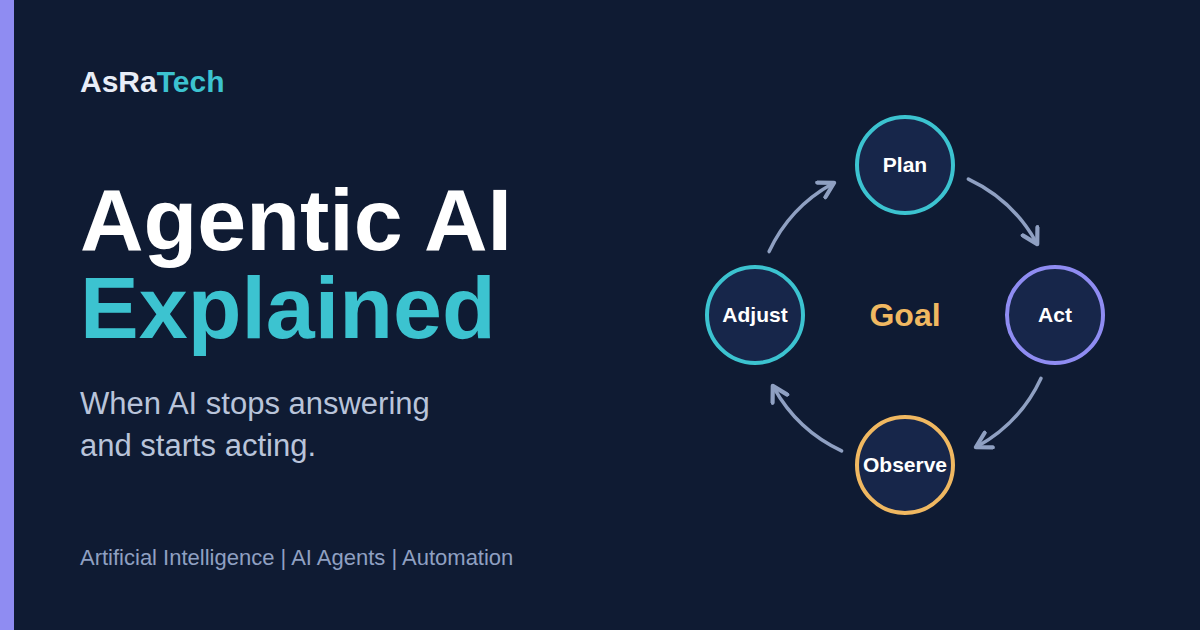
Most agents run on a simple loop: understand the goal, plan, act, observe the result, and adjust. Behind that loop are four building blocks.
A reasoning model. Usually a large language model, it interprets the goal, breaks it into steps and decides what to do next. Think of it as the agent's judgement.
Tools. These are the agent's hands. A tool might be a search function, a company database, an email system, a payment API or a code interpreter. An agent is only as capable as the tools it is allowed to use, which is also why tool access is where most of the risk lives.
Memory. Agents need to keep track of what they have already done and what they have learned. Short-term memory holds the current task. Longer-term memory can store preferences, past cases or company knowledge so the agent does not start from zero each time.
Guardrails. These are the limits: which actions are permitted, which require human approval, how much money or data the agent can touch, and when it must stop and ask. Good guardrails are what turn an impressive demo into something a business can trust.
A small example
Imagine an IT support agent at a mid-sized company. An employee writes: "I can't log in to the expense system since this morning."
A chatbot would suggest resetting your password. An agent works through the problem. It checks the account status in the identity system and sees the account was locked after several failed attempts. It confirms the employee's identity through an approved method, unlocks the account, and tests that the login works. Then it logs what it did and sends the employee a short confirmation.
If it had found something odd, such as repeated login attempts from an unfamiliar country, it would not unlock anything. It would flag the case for a human security analyst. That judgement about when to act and when to stop is the real work of designing an agent.
Where agentic AI is being used
The most practical uses today share a pattern: multi-step tasks, digital tools, and clear ways to check the result.
Software development. Coding agents can read a codebase, write changes, run tests and fix failures, with a developer reviewing the result before it goes live.
Customer operations. Agents can look up orders, check policies, process routine requests such as refunds or address changes, and hand complicated or sensitive cases to people.
IT and security operations. Agents can triage alerts, gather context from several systems and carry out routine fixes, which leaves analysts free for the genuinely difficult incidents.
Research and analysis. An agent can search multiple sources, pull the relevant material together and draft a structured summary, though a person still needs to verify the claims that matter.
Back-office workflows. Matching invoices to purchase orders, preparing reports and updating records are repetitive, rule-heavy tasks where a flexible agent can save considerable time.
Notice what these have in common. The agent handles volume and routine, and people handle exceptions and accountability.
Why it is harder than it looks
Impressive demos make agentic AI look simple. Production reality is less forgiving.
Errors compound. A single wrong answer from a chatbot is an annoyance. An agent that takes ten steps can make a small mistake in step two and build on it for eight more, producing a confident and completely wrong result.
Actions have consequences. An agent that can send emails, change records or move money can cause real damage if it misreads a situation. Wrong text can be ignored. A wrong action has to be undone.
Security is a new problem. Agents read content from emails, web pages and documents, and some of that content may contain hidden instructions written to manipulate them. This is often called prompt injection, and it means an agent should never be trusted simply because it was told something in the text it processed. Over-broad permissions make the damage worse.
Accountability is unclear. When an agent makes a bad decision, someone has to own it. Organisations need to decide in advance who is responsible and how decisions can be reviewed.
Evaluation is difficult. Testing an agent means checking whole sequences of behaviour, not single answers, and agents can behave differently from one run to the next.
It costs real resources. Agents often make many model calls per task, which adds cost and delay that a simple chatbot would not.
None of these problems is a reason to avoid agents. They are reasons to build them carefully.
How businesses can approach it sensibly
Organisations that get value from agentic AI tend to follow similar habits.
Start narrow. Pick one well-defined workflow with clear success criteria, such as resolving a specific type of support ticket, instead of aiming for a general-purpose digital employee.
Grant the least access needed. Give the agent only the tools and permissions the task requires, and nothing more.
Keep humans in the loop where it matters. Require approval for irreversible, expensive or sensitive actions, and let the agent run freely on low-risk ones.
Log everything. Record what the agent did and why, so that mistakes can be traced and corrected.
Measure honestly. Compare the agent with the current process on accuracy, time saved and cost, and include the cases where it failed.
Plan for failure. Decide what happens when the agent is unsure or something breaks, and make the handover to a person smooth.
Where this is heading
It would be unwise to predict exact milestones, but a few directions look solid. Agents will connect to more business systems, and common standards for linking models to tools are emerging to make that easier. Teams of specialised agents, each handling one part of a process, are being explored for larger workflows. And as capability grows, the questions that matter most will be about oversight: permissions, auditing, testing and clear lines of responsibility.
The likely pattern is collaboration, not replacement. Agents take on the routine and the repetitive. People set the goals, handle the exceptions and stay accountable for the outcomes.
Conclusion
Agentic AI is a real shift in what software can do: from answering questions to carrying out tasks. But it is neither magic nor a finished product. An agent is a language model plus tools, memory and rules, and its usefulness depends on how well those pieces are designed and how carefully it is supervised.
The organisations that benefit will not be the ones that hand over the most control the fastest. They will be the ones that choose the right problems, set sensible limits, and keep a human responsible for the result. Autonomy is only valuable when it can be trusted, and trust is built, not assumed.