
RAG Explained: How AI Learns to Look Things Up Before It Answers
Ask a brilliant colleague a question about your company's refund policy and they might answer from memory, confidently and slightly wrong. Ask them to check the policy document first, and the answer changes from a guess to a fact.
That small habit, looking things up before answering, is the idea behind Retrieval-Augmented Generation, or RAG. It is one of the most practical techniques in modern AI, and it is the reason many company chatbots can answer questions about private documents that no public AI model has ever seen.
This article explains what RAG is, how it works step by step, where it helps, and where it can still go wrong.
The problem RAG solves
Large language models learn from huge amounts of text during training. After that, their knowledge is frozen. This creates three practical problems for anyone building AI into a real business.
Knowledge goes stale. A model knows nothing about events, products or policies that appeared after its training ended.
Private data is missing. Your internal handbook, contracts, support tickets and product manuals were never part of the model's training. It cannot answer questions about them, however capable it is.
Models can bluff. When a model lacks the information, it may still produce a fluent, confident answer that is simply wrong. This is often called hallucination, and it is especially risky in areas like finance, law and healthcare.
One response is to retrain the model on your data, but that is expensive, slow and hard to keep current. RAG takes a simpler route. It leaves the model as it is and gives it the right information at the moment it needs to answer.
What is RAG?
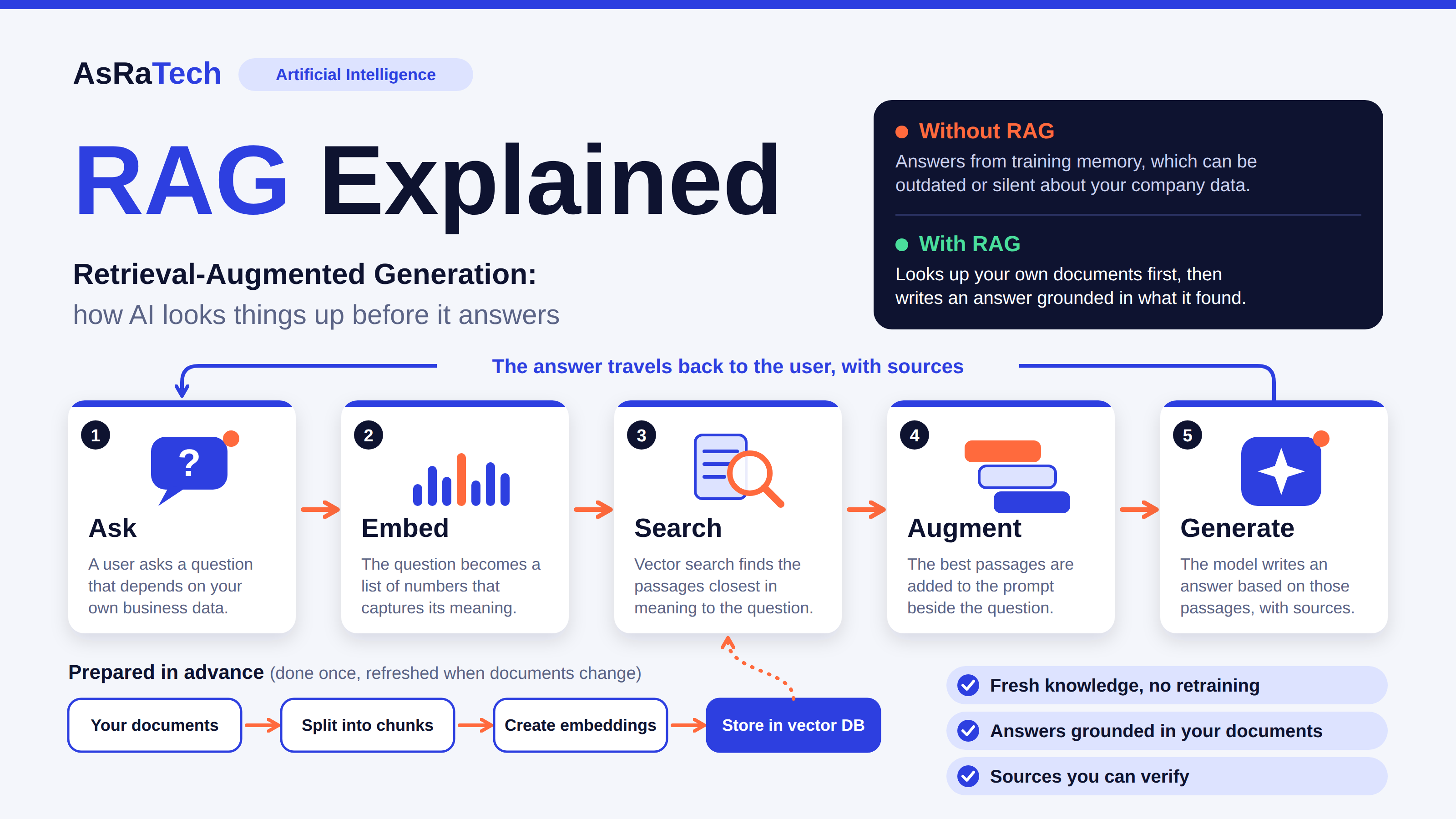
Retrieval-Augmented Generation combines two steps in one system. First, it retrieves relevant information from a trusted source such as your documents or a database. Then it generates an answer using a language model, with that retrieved information placed in front of it.
An open-book exam is a good comparison. A model without RAG sits a closed-book exam and answers from memory. A model with RAG gets to open the right pages before writing its answer. It is still the same student, but the answer is now based on the material in front of it.
How RAG works
A RAG system has two phases: one prepared in advance, and one that runs every time someone asks a question.
Phase one: preparing the knowledgeCollect the documents. These can be PDFs, web pages, wikis, support tickets, policies or database records.
Split them into chunks. Long documents are cut into smaller passages, often a few paragraphs each, so the system can find the specific part that matters instead of an entire manual.
Create embeddings. Each chunk is converted into a list of numbers called an embedding, which captures its meaning. Passages about similar topics end up with similar numbers, even if they use different words.
Store them in a vector database. These embeddings are saved in a database built for fast similarity search. This preparation is done once and refreshed when documents change.
Phase two: answering a questionAsk. A user types a question, such as "How long do customers have to return a damaged item?"
Embed the question. The question is converted into numbers in the same way as the document chunks.
Search. The system looks for the stored passages whose meaning is closest to the question. This is why a question phrased differently from the document can still find the right passage.
Augment the prompt. The best passages are added to the prompt alongside the original question, with instructions to answer using that material.
Generate. The language model writes an answer based on the supplied passages and, ideally, points to the sources it used so a person can check them.
The result is an answer grounded in your own documents, produced in natural language.
A small example
Imagine a software company whose support team keeps getting questions about licence terms. A customer asks: "Can I use one licence on two laptops?"
Without RAG, a general model might give a typical answer about software licences, which may not match this company's actual terms. With RAG, the system retrieves the two paragraphs of the licence agreement that cover device limits, hands them to the model, and the model replies with the company's real policy and a reference to the clause. If the policy changes next month, updating the document is enough. Nobody has to retrain anything.
Where RAG is useful
RAG fits any situation where answers must come from specific, changing or private information.
Customer support. Assistants can answer from product manuals, policies and past tickets, and hand difficult cases to a person.
Internal knowledge assistants. Employees can ask questions about HR policies, onboarding steps or IT procedures instead of searching through folders.
Legal and compliance work. Teams can find relevant clauses or regulations quickly, with the source passage shown so a professional can verify it.
Research and analysis. RAG can pull together material from many reports and summarise it with references.
Developer tools. Assistants can answer questions about a company's own codebase and documentation, not just general programming knowledge.
In each case, the value is the same: a conversational interface on top of information the model was never trained on.
RAG compared with fine-tuning
People often ask whether they should use RAG or fine-tune a model on their data. They solve different problems.
Fine-tuning adjusts a model's behaviour: its tone, format, or skill at a specialised task. It is not a reliable way to teach a model large amounts of fresh factual content, and the knowledge is hard to update or trace.
RAG supplies facts at question time. It is easier to update, makes it possible to show sources, and keeps sensitive documents under your own access controls. Many real systems use both: fine-tuning for style and skill, RAG for knowledge.
Where RAG can go wrong
RAG reduces the problem of made-up answers. It does not remove it. A model that receives good passages can still misread them, and a model that receives poor passages will build a poor answer on them.
Retrieval quality is everything. If the search finds the wrong passages, the model answers from the wrong material. Weak chunking, poor embeddings or ambiguous questions all cause this.
Bad source data gives bad answers. If documents are outdated, contradictory or badly written, the system will faithfully repeat those flaws. Someone has to keep the knowledge base clean.
Missing information needs handling. A well-built system should say "I could not find that in the documents" instead of guessing. This has to be designed deliberately.
Access control matters. If an employee is not allowed to see a confidential document, the assistant must not retrieve it for them. Permissions must carry through the retrieval step.
Security risks exist. Retrieved text can contain hidden instructions written to manipulate the model, a problem known as prompt injection. Content from untrusted sources should be treated with caution.
It adds cost and delay. Searching, retrieving and longer prompts mean extra processing for every question.
Building RAG well
Teams that get reliable results tend to follow a few habits.
Start with the documents. Clean, current and well-organised source material matters more than any clever technique.
Test retrieval on its own. Check whether the right passages are found for real questions before judging the final answers.
Show sources. Citations let users verify answers and help the team spot errors.
Measure with real questions. Build a set of representative questions with known correct answers and test against it after every change.
Keep a human option. For high-stakes decisions, make sure people can review, correct and escalate.
Where this is heading
RAG is evolving quickly. Systems are getting better at handling long documents, mixing text with tables and images, and deciding for themselves when to search and what to search for, which connects RAG to the broader idea of AI agents. Exact milestones are hard to predict, but the direction is clear: more attention on retrieval quality, evaluation, security and trust.
Conclusion
RAG is not a mysterious new kind of intelligence. It is a sensible piece of engineering built on a simple idea: do not ask a model to remember everything, give it the right information when it matters.
That makes it one of the most practical ways to bring AI into real work. But its success depends on unglamorous things: good documents, good search, honest handling of gaps and careful oversight. Get those right, and an AI assistant stops sounding merely fluent and starts being genuinely useful.