
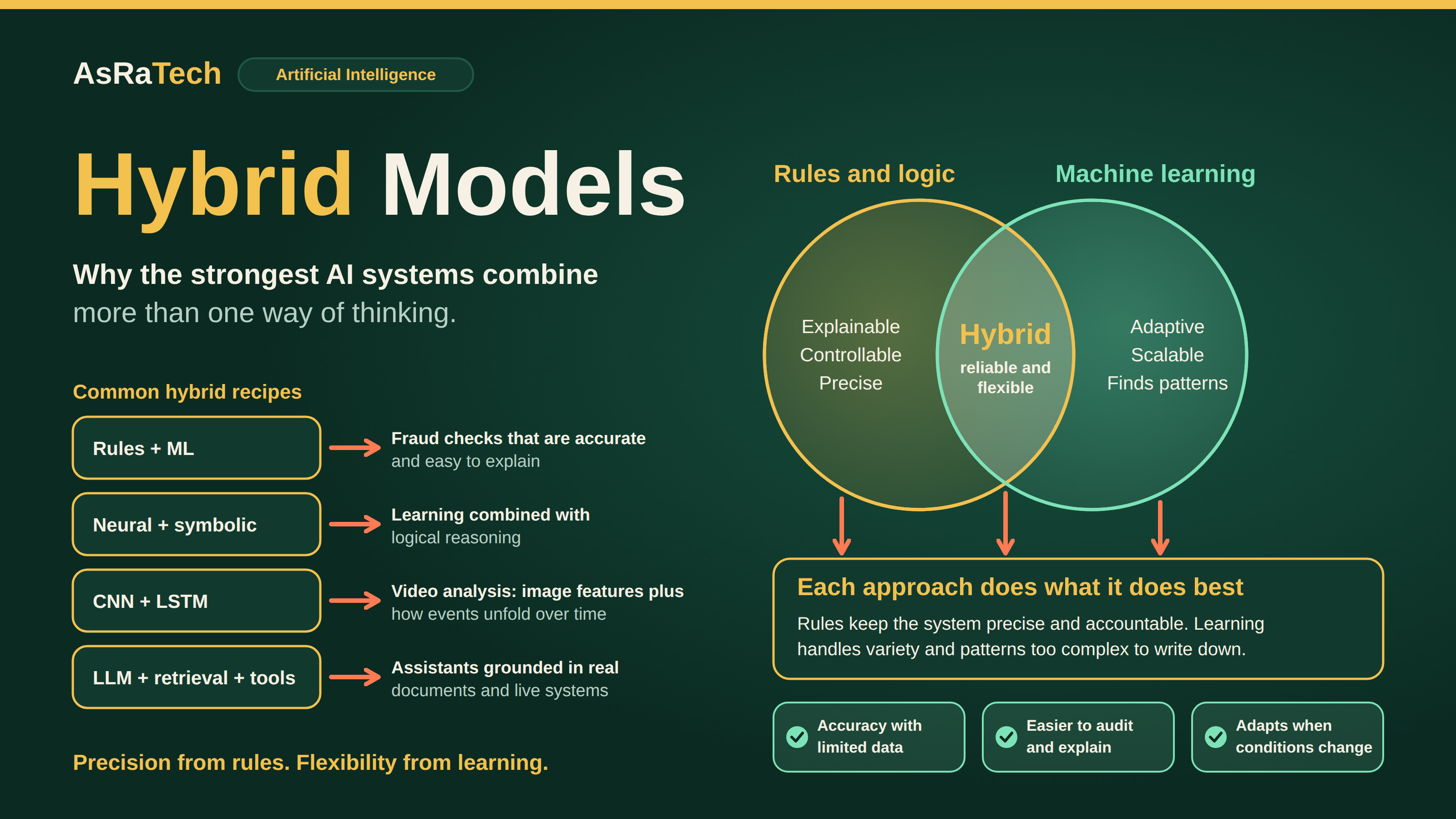
Hybrid Models: Why the Smartest AI Systems Rarely Rely on Just One Idea
A calculator never makes an arithmetic mistake, but it cannot recognise a face. A neural network can recognise a face, but it can quietly get arithmetic wrong. The most capable AI systems today often pair the two.
That pairing is the core idea behind hybrid models. In the early days of AI, researchers argued about which single approach would win: hand-written rules or systems that learn from data. In practice, the strongest real-world systems rarely pick a side. They combine approaches so that each covers the other's weaknesses.
This article explains what hybrid models are, why they matter, the main ways they are built, where they are used, and what makes them harder to get right than they sound.
What is a hybrid model?
A hybrid model is an AI system that combines two or more different techniques to solve a single problem. The pieces might be different types of algorithm, different kinds of knowledge, or different stages of a pipeline.
The term is used broadly, so it helps to be precise. Some hybrids mix rules with machine learning. Others mix neural networks with symbolic reasoning, which means working with explicit logic and structured knowledge. Others join two kinds of neural network, each suited to a different type of data. And many modern assistants combine a language model with search, databases and tools.
What they share is a design philosophy: instead of asking one method to do everything, give each method the part of the job it does best.
Why one approach is rarely enough
Each major approach to AI has real strengths and real blind spots.
Rule-based systems are transparent and predictable. You can read the rules, audit them, and be sure the system will never cross a line you have drawn. But they are brittle. They struggle with messy input and anything the rule-writer did not foresee, and writing rules for complicated situations quickly becomes unmanageable.
Machine learning systems learn patterns from data, so they handle variety and complexity very well. But they can be hard to explain, they depend heavily on the quality of their training data, and they can make confident mistakes. Without extra safeguards, they offer no hard guarantees.
Looked at side by side, the weaknesses of one are largely the strengths of the other. That is the case for hybrids in a sentence: rules provide precision and accountability, while learning provides flexibility and scale.
The main kinds of hybrid models
Rules combined with machine learningThis is the most common and most practical form. A learned model makes a prediction, and a layer of business rules reviews or constrains it.
Take fraud detection. A model learns what suspicious transactions look like and scores each one. Rules then add certainty on top: always block payments to a sanctioned account, always require extra verification above a set amount, never auto-decline certain categories of customer. The model handles the fuzzy judgement, and the rules enforce the policies that must never be broken.
Neural and symbolic reasoningNeural networks are excellent at perceiving the world: images, speech, text. Symbolic systems are excellent at reasoning with explicit facts and logic. A neuro-symbolic hybrid uses a neural network to turn messy input into structured information, then applies logical reasoning to that structure.
Imagine a system answering questions about a diagram. The neural part identifies the objects and their positions. The symbolic part reasons about them, such as which object is to the left of another, or whether a condition holds. This is an active research area, and it is attractive because it aims to combine learning with reasoning that can be inspected.
Combining different neural architecturesSometimes the hybrid is built entirely from neural components, each chosen for a different job. A well-known example pairs a convolutional network, which is good at extracting visual features, with a recurrent or sequence model, which is good at understanding how things change over time. Together they can analyse video: the first component describes what is in each frame, and the second tracks what happens across frames.
Models combined with physical or scientific knowledgeIn engineering and science, a model can be anchored to known physical laws, with machine learning filling in what the equations cannot capture. A system forecasting equipment wear might use physics to describe how heat and stress behave, and learning to correct for real-world conditions that the physics does not account for. The result can be more reliable, especially when there is limited data.
Language models with retrieval and toolsMany modern AI assistants are hybrids of this kind. A language model handles conversation and reasoning in natural language. A retrieval step finds relevant documents, as in RAG. Tools, such as calculators, databases and code interpreters, handle tasks where exactness matters. The model decides what to use and when, and the tools supply the precision the model lacks on its own.
Small and large models working togetherA newer hybrid pattern is routing. A small, fast model handles the simple, high-volume requests, and a larger, more capable model is called only when a request is genuinely difficult. This keeps costs and response times down without giving up quality where it matters.
A small example
Consider a bank assessing loan applications.
A purely rule-based system would apply a fixed checklist: minimum income, maximum debt ratio, no recent defaults. It is clear and consistent, but it rejects many people who would have repaid, and approves some who should not have been approved, because a checklist cannot capture subtle patterns.
A purely learned model could weigh hundreds of signals and perform better on average. But it might be impossible to explain to an applicant why they were declined, and it could drift into unfair patterns hidden in historical data.
A hybrid does both. A model estimates risk from the full picture. Rules enforce legal requirements and company policy, and flag cases where the model is uncertain or where the stakes are high. Those cases go to a human reviewer. The decision is better informed than the checklist and easier to defend than the model alone.
What hybrid models offer
Better results with limited data. Rules and domain knowledge can fill gaps where there are not enough examples to learn from.
Easier to explain and audit. When part of a decision comes from clear rules, it is easier to trace and justify.
Built-in safeguards. Hard constraints can stop a learned model from taking actions that are never acceptable.
Flexibility. Learning components adapt to variety and change, so the system does not break the moment reality departs from the script.
Efficiency. Using the right tool for each step, including smaller models for simple tasks, can reduce cost and delay.
What makes hybrids hard
Combining approaches is powerful, but it is not free.
More moving parts. Each additional component is something to build, test, monitor and maintain. Complexity is the price of capability.
Integration is difficult. Getting a learned model and a rule engine to cooperate cleanly takes careful design. What happens when they disagree? Which one wins, and who decides?
Errors can travel. A mistake in an early component, such as a misread input, can flow through to everything downstream.
Rules need upkeep. Business rules go out of date, and a stale rule inside a hybrid quietly overrides a perfectly good model.
Testing is harder. You have to evaluate each part and the whole system, including how the parts interact.
Fashionable labels mislead. Calling a system "hybrid" or "neuro-symbolic" says nothing about whether it works. The only test is whether it solves the problem better than a simpler alternative.
Designing a hybrid sensibly
Teams that build hybrids well usually follow a few habits.
Start from the problem, not the technique. Identify where learning is genuinely needed and where a simple rule is enough. Not every step needs a model.
Give each component a clear job. Decide in advance what each part is responsible for, and what happens when parts disagree.
Put hard limits in rules. Anything that must never happen, such as legal requirements and safety constraints, should be enforced explicitly instead of left to a model's judgement.
Keep humans in the loop for high stakes. Route uncertain or consequential cases to people, with enough context to decide.
Measure the whole system. Compare against a simpler baseline and check that the added complexity actually earns its keep.
Where this is heading
Hybrid thinking is likely to become more common, not less. As AI systems take on larger tasks, they increasingly resemble teams of components: models that perceive, models that reason, tools that calculate, retrieval systems that supply facts, and rule layers that enforce limits. Exact developments are hard to predict, but the direction is consistent: less emphasis on finding one perfect method, more emphasis on assembling the right parts and keeping the whole system trustworthy.
Conclusion
Hybrid models are not a trend so much as a recognition of how problems actually look. Real tasks are rarely all pattern recognition or all logic. They involve judgement and rules, flexibility and guarantees, speed and care.
The most useful AI systems are often those that respect this. They let learning handle what is too complex to write down, let rules protect what must never go wrong, and keep people responsible for outcomes that matter. In that sense, "hybrid" is less a technical category than a sensible way of building: use each tool where it is strongest, and be honest about where it is not.